22nd March 2026 09:00 – 12:30
We began our exploration right by the car park, where the first discoveries were already waiting. Beneath the pine trees we talked about the many uses of pine (samples: pine soda ). Nearby we looked at plantain and discussed its traditional uses as a wild remedy.
At the corner of the car park, we found our first spring greens. Dead nettle (samples: dead nettle tea and fresh white and red dead nettle) was a great introduction to how common “weeds” can be delicious and useful. Next to the dead nettle was also a patch of stinging nettle, we discussed several ways to use it (samples: nettle crisps, nettle kimchi and nettle seeds).
We also stopped to identify Veronica / speedwell and its beautiful blue flowers. Next to it, with even smaller flowers, we counted the petals of white flowering chickweed (samples: fresh leaves), a mild and nutritious winter green.
Turning onto the path, the hedgerow began to offer even more edible finds. Cleavers (samples: cleavers tonic) were growing vigorously, and we tasted some cow parsley fresh from the hedge (samples: fresh leaves). Nearby we also spotted silverweed, another traditional wild edible connected to femininity.
At the clearing near the main entrance to the park we paused for a bit. Here we even found our first fungi.
We looked at thistle and demonstrated how the stems can be eaten fresh (samples: fresh thistle stems), which became a fun surprise activity, where participants had to guess what they had just eaten.
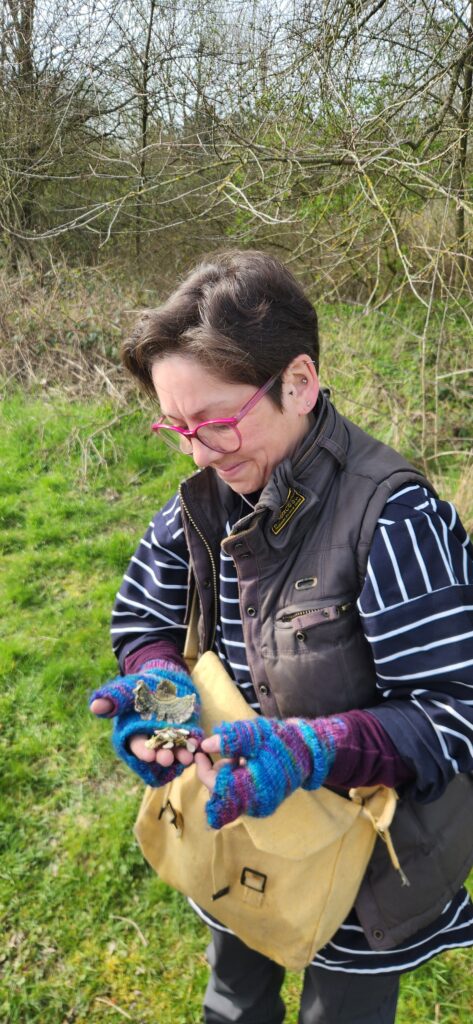
We also examined a small mushroom, Tubaria furfuracea, which allowed us to demonstrate the fascinating hygrophanous property of some fungi.
Walking into the park, we encountered rose (samples: rose tea) and learn about wasp gall – Robins pin’s cushion with use as cold sore remedy.
A particularly important learning moment came when we found hemlock. We discussed its identification carefully and compared it with cow parsley, confirming that nobody confused the two — an excellent example of why careful identification is so important.
This clearing also became our mushroom learning station.
Here we demonstrated several fascinating fungal features:
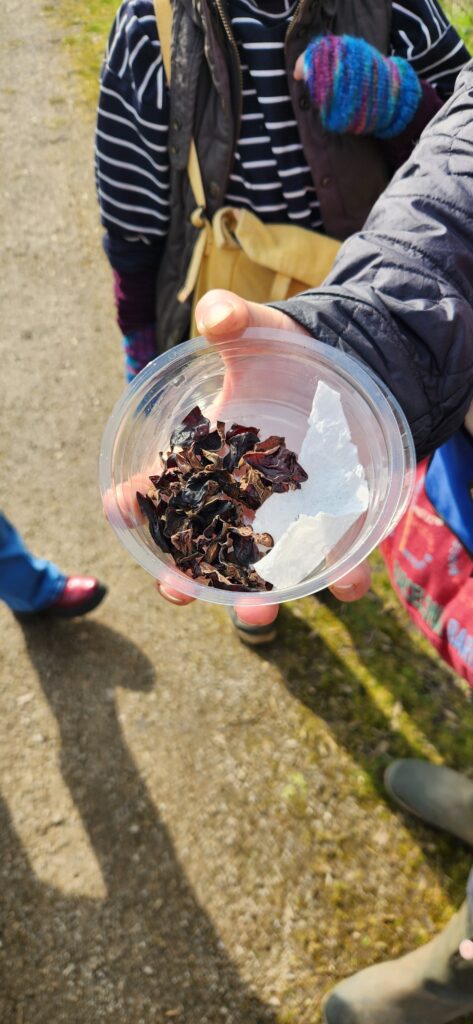
- Jelly ear growing with a bit of water (tasting crisps)
- Scarlet elfcups and how some fungi release spores by shooting them in the air rather them dropping them.
- Blackfoot mushroom identification
- Birch polypore growing on silver birch, including tasting a little birch sap
Even in early spring, the fungal world was surprisingly active.
Before entering the woodland we have talked about lime decease and teasel salvation.
To cheer us up after this bit a gloom, we admired lovely primroses and tasted prewashed fresh leaves and crafted crystalized flowers. (pls follow the process for crystalized violet – it is the same for primroses)
Continuing along the main path towards the T-Junction, we found a patch of ground elder, one of the most abundant edible greens of spring. (tasted fresh and as addition to Bhaji) and on the path next to the ground elder we spotted the Dandelion and its so many edible uses (samples: dandelion jelly/honey and pickled buds and Bhaji ale dandiliona , smell root coffee)
We also paused to compare blackthorn and hawthorn, learning how to tell them apart by their early leaves (samples: fresh young leaves) or early flowers.
Other plants growing along the path:
Further along the path we encountered even more useful species:
Elder tree, we sampled a traditional berry cordial (samples: elderberry cordial)
Garlic mustard (samples: fresh leaves and seeds)
Cherry plum (samples: cherry plum jam, Hawthorn and Cherry Plum wine) Follow recipe for hawthorn wine but replace part of hawthorn with plums – keep stones in.
Coming nearly to the end of our adventure, we had to stop by the classic foragers delight: Bramble (samples: blackberries cordial)
With time running short we made one final stop at the finishing line post to discover edible when cooked common hogweed with its special taste -of what, we can not agree upon- but who cares? What matters is, that it tastes great in Charnwood Foraging Signature chocolates. (hogweed chocolates), a surprisingly delicious way to end our spring foraging course.
A
Thank you to everyone who joined us for this Sunday morning nature exploration adventure.
If you’d like to refresh your learning, you can join one of our upcoming courses with a special refresher price – book directly though jo@charnwoodforaging.co.uk showing your original order or the email showing the info of the course you attended.