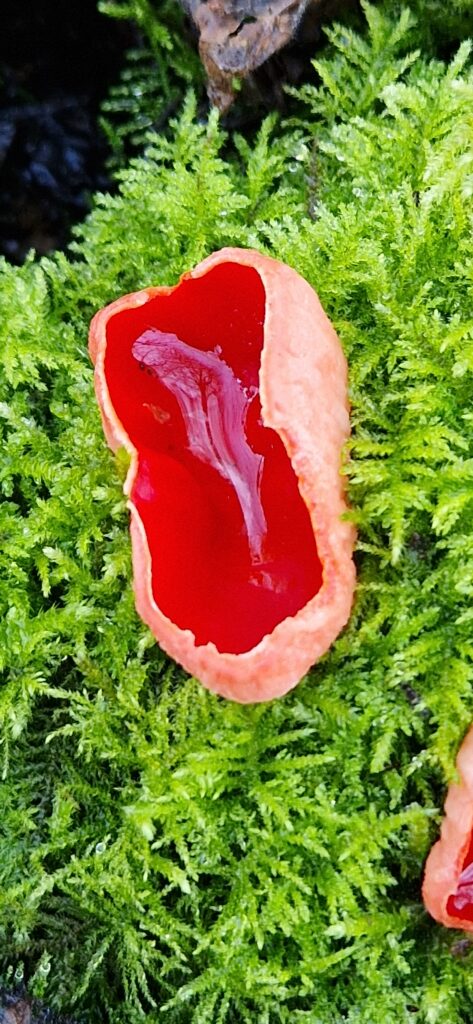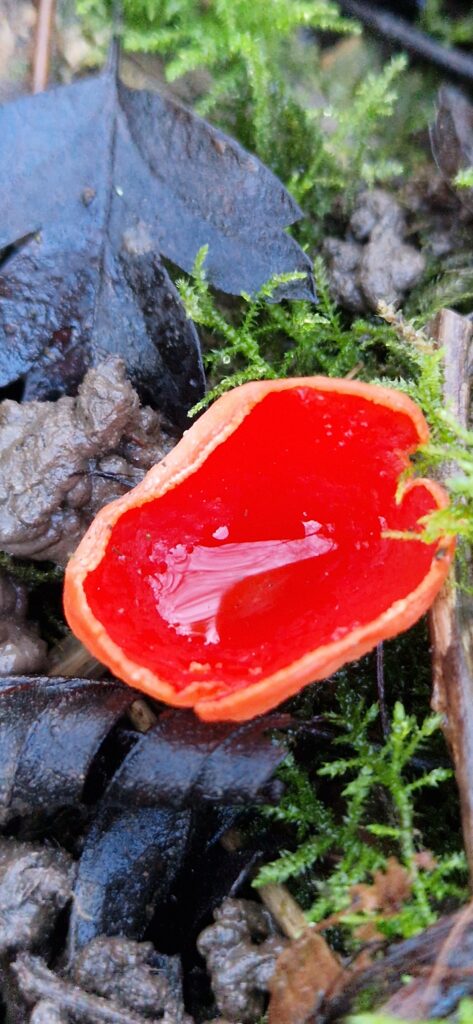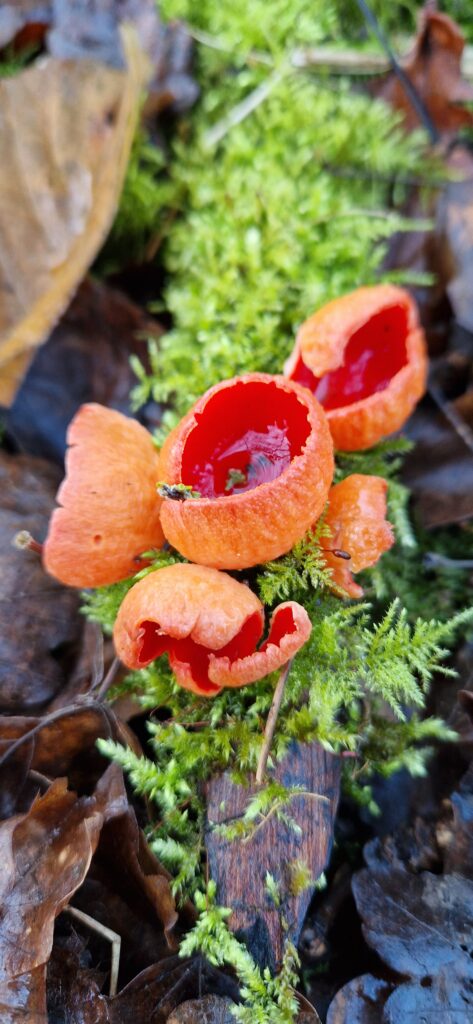
The Scarlet Elfcup is a striking fungus that brightens the forest floor with its vivid red hue. This eye-catching species is a favorite among foragers and nature enthusiasts, though it is more admired for its beauty than for its culinary applications.
Not sure about mushroom identification? Join us for the next foraging course in Charnwood, Leicestershire, and learn how to safely identify fungi in the wild.
Habitat
The Scarlet Elfcup thrives in damp, decaying woodlands, particularly on fallen branches, twigs, and rotting logs. It is most commonly found in well-shaded, moist areas from late autumn through early spring. Look for its vibrant red cups nestled among moss and leaf litter.
Identification Features
Fruitbody:
The fruitbody is cup-shaped to saucer-like, measuring 2–6 cm across. Its upper surface is a deep scarlet red, while the exterior is pale and slightly hairy.
Texture:
The fungus is firm yet brittle, with a slightly rubbery consistency when fresh.
Spore Print:
The spore print is white, though rarely needed due to the fungus’s distinctive appearance.
Smell and Taste:
The Scarlet Elfcup has a mild, earthy smell and an unremarkable taste.
Lookalikes
Ruby Elfcup (Sarcoscypha austriaca):
Nearly identical to the Scarlet Elf Cup, this species requires microscopic examination to distinguish between them. Both are equally safe.
Orange Peel Fungus (Aleuria aurantia):
Unlike the Scarlet Elfcup, this species grows on soil rather than wood and has a more orange coloration.
Edibility
The Scarlet Elfcup is considered edible when cooked, though it is not widely used in cuisine. Its primary appeal is its vibrant color, which makes it a decorative addition to salads and garnishes. Always cook before consuming, as raw specimens may cause mild digestive discomfort.
Ecological Role
As a saprotrophic fungus, the Scarlet Elfcup helps break down decaying wood, recycling nutrients back into the ecosystem. Its presence in woodlands indicates a healthy environment rich in biodiversity.
Foraging Season
The Scarlet Elfcup appears from winter to early spring, with peak abundance in winter. Its bright red cups stand out against the dull winter landscape, making it easier to spot among fallen branches and mossy logs.
Health Warning
Although the Scarlet Elfcup is not toxic, accurate identification is crucial, as some cup fungi can be harmful. Avoid collecting specimens from polluted or pesticide-exposed areas.
Discover the vibrant world of fungi, including the Scarlet Elfcup, by joining one of our foraging courses in Charnwood, Leicestershire.