
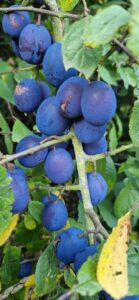
Latin Name: Prunus domestica
Other Names: Wild Plum, Damson Plum
Habitat
The Damson tree (Prunus domestica subsp. insititia) is native to Europe and western Asia. It thrives in well-drained, fertile soils and prefers sunny spots or partial shade. Often found in hedgerows, woodlands, and orchards, Damsons are valued both for their distinctive fruit and their ornamental appeal.
🌳 Want to learn more about Damsons and other wild trees? Join our next foraging event in Charnwood, Leicestershire, to improve your foraging skills.
Appearance
Leaves
- Oval to lance-shaped, with finely serrated edges.
- Dark green in summer, turning yellow in autumn.
- Typically 5–10 cm long, arranged alternately on the branches.
Flowers
- Small, white to pink, five-petaled flowers that bloom in early spring.
- Attract pollinators such as bees and butterflies.
Stem
- Smooth, reddish-brown bark with horizontal lenticels.
- Older trees may develop rougher, more fissured bark.
Fruit/Seeds
- Small, oval-shaped fruits with a rich purple or blue skin.
- Tart, astringent flavor when raw, but sweetens when cooked.
- Contains a single large stone inside.
Edibility & Recipes
Damsons are prized for their unique, tart flavor:
- Raw: While tart and astringent, Damsons can be enjoyed fresh for those who appreciate a sharp taste.
- Jams & Jellies: A classic use for Damsons, creating a rich, flavorful spread.
- Baking: Perfect for pies, crumbles, or cakes. (Christmas Damson Jam Mince Pies with Starry Tops)
- Sauces & Chutneys: The tartness of Damsons lends itself well to savory dishes and condiments.
- Beverages: Use in making wines, cordials, or infused spirits.
Health Benefits
Damsons are packed with essential nutrients:
- Vitamin C: Strengthens the immune system and promotes skin health.
- Dietary Fiber: Supports digestive health and regularity.
- Antioxidants: Help protect cells from oxidative damage.
- Anthocyanins: May help reduce inflammation and improve heart health.
Foraging Season
The best time to forage Damsons is in late summer to early autumn, when the fruits have ripened and taken on their characteristic dark color. Look for fruit that has softened slightly for the best flavor.
Folklore & Interesting Facts
- Historical Significance: Damsons have been cultivated since Roman times, often in walled gardens to protect the delicate fruits.
- Cultural Associations: In the UK, Damsons are often used in traditional recipes for winter preserves.
- Wild Hybrids: Damsons are a wild relative of the domesticated plum and are often used in breeding new fruit varieties.
Health Precautions
- Damson seeds, like other stone fruits, contain cyanogenic compounds that can release cyanide when consumed in large amounts. Avoid eating the seeds.
- Always ensure the fruit is ripe before consuming, as unripe Damsons can be overly tart and astringent.
✨ Want to learn more about foraging and the wonders of wild fruit? Join our foraging events in Leicestershire and explore the diverse world of Damsons and other wild plants!
