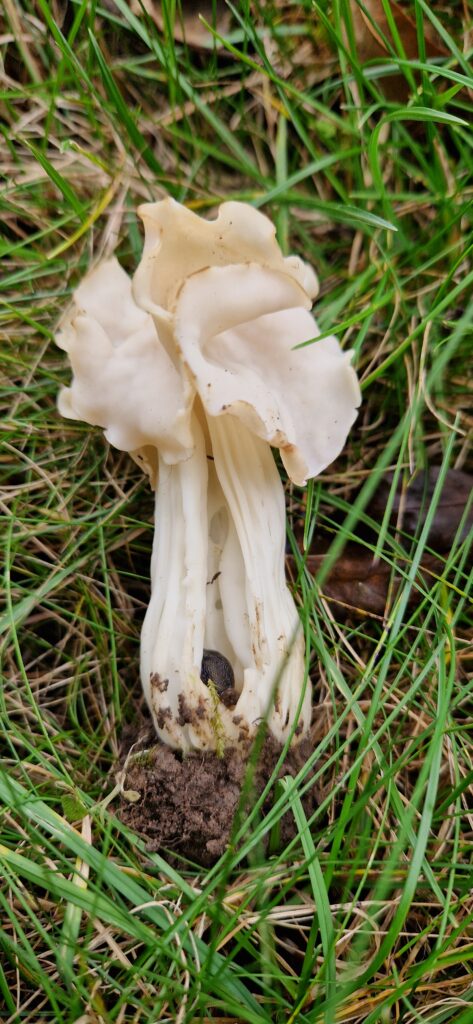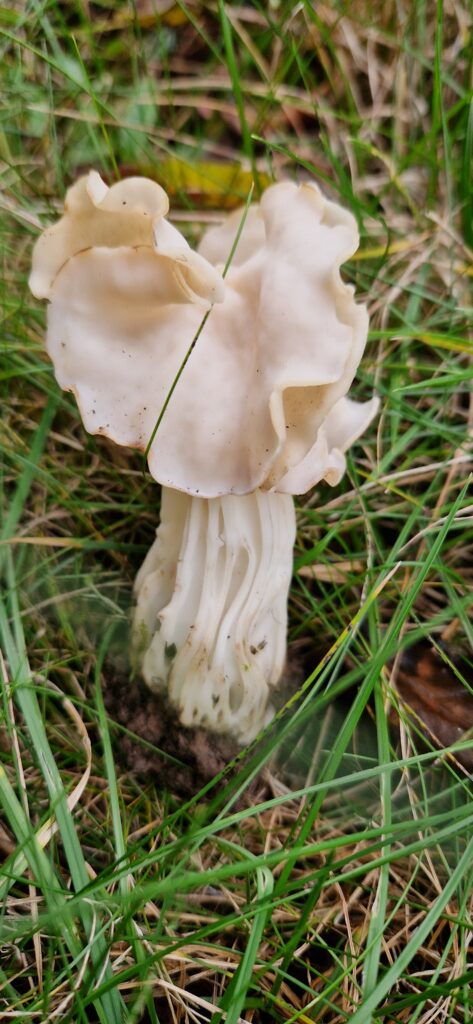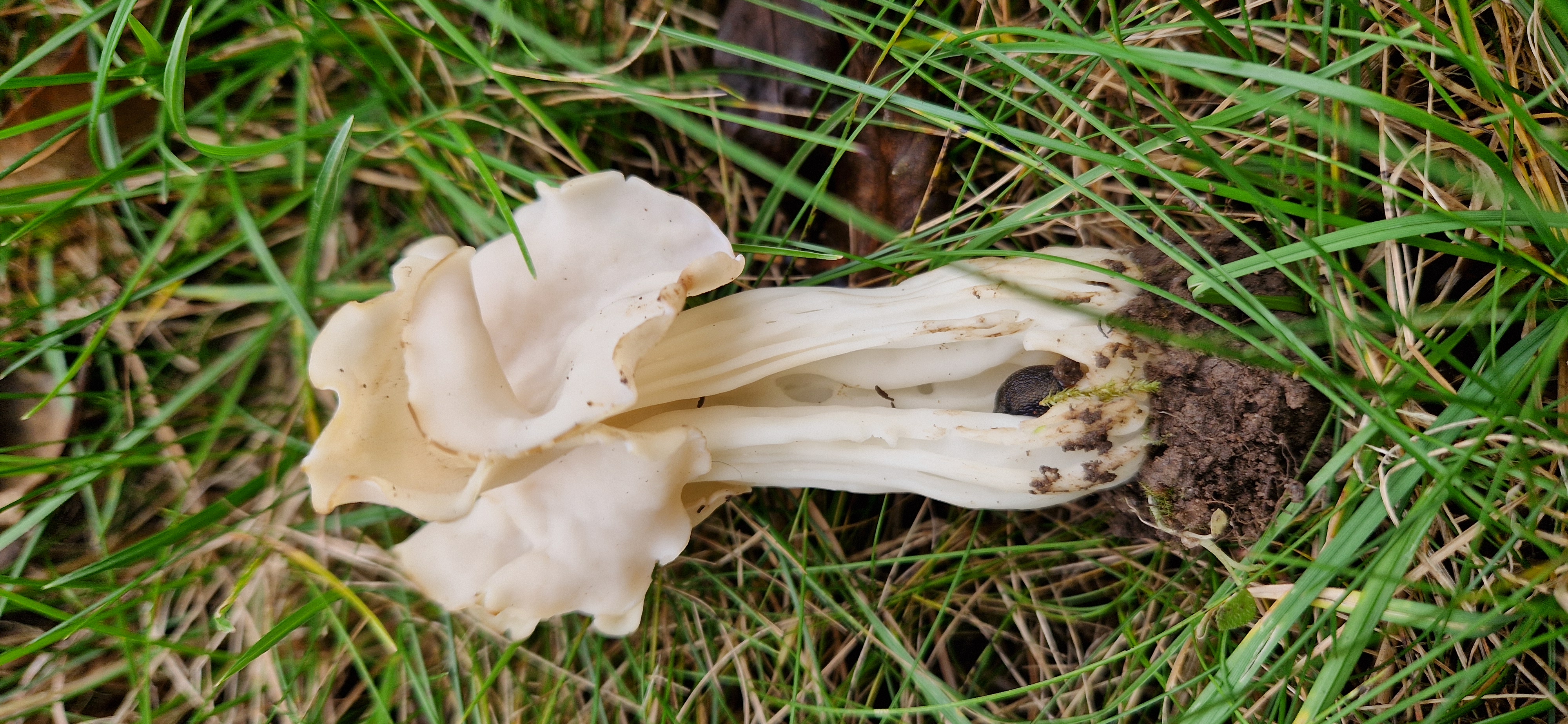
White Saddle Mushroom (Helvella crispa) is a striking and unusual fungus known for its distinctive saddle-shaped cap. This species is often found in woodland areas and is prized for its unique appearance, though it is not typically sought after for culinary use.
Not sure about mushroom identification? Join us for the next foraging course in Charnwood, Leicestershire, and learn how to safely identify fungi in the wild.
Habitat
The White Saddle Mushroom grows in forests and woodlands, particularly in areas with rich, well-drained soils. It can often be found among leaf litter, on decaying wood, or in grassy patches. Its appearance is most common in late summer and autumn, especially in areas with high moisture levels.
Identification features
Cap:
The cap of the White Saddle Mushroom is roughly saddle-shaped, with irregular folds and a distinct, wavy edge. It measures 4–12 cm in width and is white to pale cream in color, sometimes with a slightly yellowish tinge. The surface is smooth and sometimes shiny.
Stem:
The stem is slender and pale, ranging from 5–10 cm in height. It is typically white to pale beige and smooth in texture, tapering slightly toward the base.
Texture:
The fungus has a soft, spongy texture, especially around the folds of the cap, which gives it a somewhat fragile appearance.
Spore Print:
The spore print is white, which helps differentiate it from similar-looking species.
Smell and Taste:
The White Saddle Mushroom has a mild, earthy smell and taste, though it is not commonly eaten.
Lookalikes
- Devil’s Urn (Urnula craterium): This species is also saddle-shaped but darker in color, ranging from brown to black, and typically grows on decaying wood.
- Common Helvella (Helvella acetabulum): Similar in shape but more cup-like in structure and darker in color.
Edibility
The White Saddle Mushroom is not considered edible in its raw form. It contains compounds that may cause gastrointestinal distress if consumed uncooked. In some cultures, it is eaten after thorough cooking, but it is not recommended for general consumption. See note in black saddle.
Ecological role
As a saprotrophic fungus, the White Saddle Mushroom plays a role in breaking down organic matter, particularly decaying plant material and wood. This decomposition helps return essential nutrients to the soil, supporting forest health and biodiversity.
Foraging season
The White Saddle Mushroom typically appears from late summer to autumn, thriving in moist conditions. It is often found in shaded, woodland habitats, sometimes growing in clusters.
Health warning
Due to potential toxicity when consumed raw, the White Saddle Mushroom is not recommended for foraging or eating. Ensure proper identification and preparation before considering any wild fungi for consumption.
Discover the fascinating world of fungi, including the White Saddle Mushroom, by joining one of our foraging courses in Charnwood, Leicestershire. Learn how to identify wild mushrooms and understand their ecological importance!