
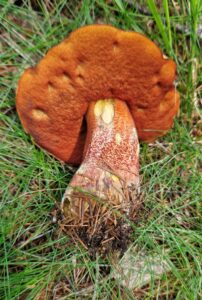
The Scarletina Bolete (Neoboletus luridiformis), also known as the “Red-stemmed Bolete” or “Lurid Bolete,” is a striking member of the Boletaceae family. This mushroom is renowned for its vibrant coloration and distinctive features, making it a captivating subject for both mycologists and mushroom enthusiasts.
Other names: “Red-stemmed Bolete” or “Lurid Bolete,”
Not sure about plant identification? Join us for the next foraging event in Charnwood, Leicestershire.
Habitat
- The Scarletina Bolete thrives in symbiotic relationships with deciduous and coniferous trees, particularly favoring beech, oak, and pine. It is commonly found in mixed woodland environments across Europe and parts of North America, emerging from the forest floor during the warm, humid months of summer and early autumn.
Identification features
- Cap: 5–20 cm wide, olive-brown to reddish-brown, often velvety when young and becoming smoother with age. The flesh turns vivid blue when cut or bruised, a characteristic reaction common in this group.
- Stem (Stipe): 5–15 cm tall and 2–4 cm thick. The stem is usually yellow with red dots or streaks, especially toward the base. It is not reticulate (no net-like pattern). This is a key distinguishing feature from some similar species.
- Pores: Initially yellow, quickly turning to orange-red. The pore surface also stains blue when bruised.
- Spore print: Olive-brown.
Edibility
- The Scarletina Bolete is edible only after thorough cooking. It should never be eaten raw, as raw specimens can cause gastrointestinal upset
Recipes
Great for pickling, soups or just fried with butter or made into omelets.
Czech: smaženice – mushroom mix fried with onion, butter and eggs
Mushroom in breadcrumbs- deep fried
Vitamins Content/Health Benefits
Mushrooms contain antioxidants such as ergothioneine and selenium, which help protect cells from damage caused by free radicals and oxidative stress. Antioxidants play a role in reducing the risk of chronic diseases such as heart disease, cancer, and neurodegenerative disorders.
Foraging season
- August to November but with climate change impact these can now be found even in June, July.
Health warning
- Remember, when foraging for wild mushrooms, it’s crucial to be absolutely certain of the identification, as some poisonous mushrooms can resemble edible ones. It’s best to consult with an expert or field guide if you’re uncertain