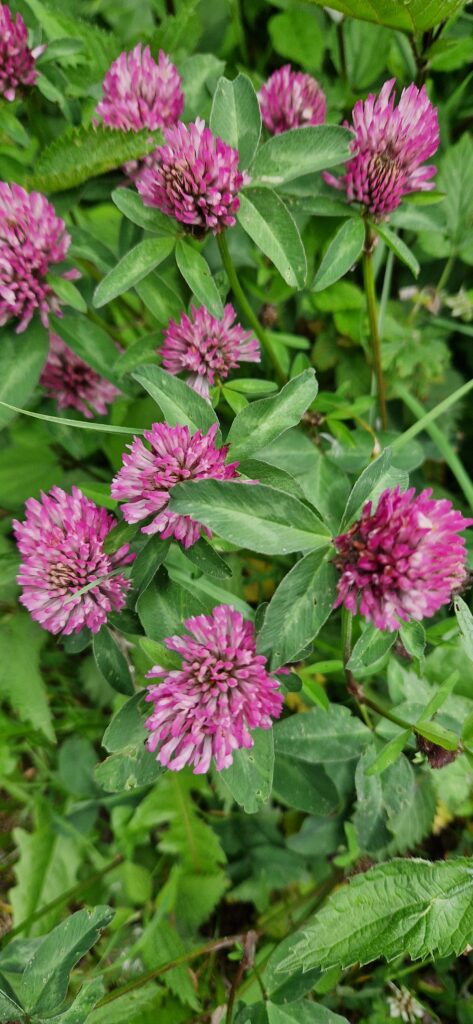
Latin Name: Trifolium pratense
Family: Fabaceae
Other Names for Red Clover:
- Meadow Clover
- Cow Clover
- Purple Clover
- Trébol Rojo (Spanish)
- Trèfle Rouge (French)
There are several hundreds of clovers. White variety was used during the war to replace flour, purple varieties have more known medicinal properties. Edibility applies to all species growing in the UK.
Habitat
Red Clover thrives in:
- Grasslands
- Meadows
- Roadsides
- Pastures
- Open woodlands
- Waste areas
Not sure about plant identification? Join us for the next foraging event in Charnwood, Leicestershire, to learn hands-on!
Appearance
Leaf Description:
- Leaves are trifoliate, with three leaflets per stem.
- Leaflets have a distinctive pale V-shaped marking.
Flower Description:
- Flowers are round and vibrant pinkish-red.
- Clustered tightly in a globular head.
Stem Description:
- Stems are slightly hairy and hollow, growing up to 50 cm tall.
Fruit/Seed Description:
- Produces small pods containing a single yellowish-brown seed.
Edibility
Red Clover is a versatile and nutritious wild edible.
- Flowers: Use fresh or dried for teas, infusions, or garnishing salads.
- Leaves: Add to soups, stews, or as a leafy green substitute.
- Sprouts: Germinate seeds for nutrient-dense sprouts.
Recipes
- Red Clover Blossom Tea
- Red Clover Syrup
- Red clover on eggy toast
Vitamin Content/Health Benefits
Rich in nutrients, Red Clover contains:
- Vitamins: A, B-complex, C, and E.
- Minerals: Calcium, magnesium, potassium, and iron.
Health Benefits:
- Supports hormonal balance, particularly during menopause.
- May aid in improving skin health and reducing inflammation.
- Contains isoflavones believed to support cardiovascular health.
Foraging Season
- Flowers: Spring through late summer.
- Leaves: Year-round (best when young).
Folklore/Interesting Info
- Red Clover symbolizes protection and good luck in many cultures.
- Historically used to ward off evil spirits and bring prosperity.
- A staple in traditional herbal remedies for coughs, colds, and cleansing the blood.
Health Warning
While Red Clover is generally safe, consult a healthcare provider if you:
- Are pregnant or breastfeeding.
- Take medications for blood thinning or hormone-sensitive conditions.
Red Clover may interact with certain medications, so caution is advised.
Not sure about plant identification? Join us for the next foraging event in Charnwood, Leicestershire.