
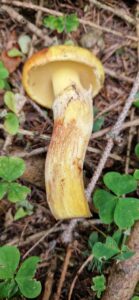
The Larch Bolete, scientifically known as Suillus grevillei, is a distinctive wild mushroom commonly found in association with larch trees. This mushroom is appreciated by foragers for its bright, eye-catching color and its place in the culinary world, particularly in Central and Eastern European cuisine.
Other names: “Greville’s Bolete” or “Larch Suillus.”
Not sure about plant identification? Join us for the next foraging event in Charnwood, Leicestershire.
Habitat
Larch Boletes are mycorrhizal, meaning they form symbiotic relationships with larch trees (Larix spp.). They are typically found in larch plantations and mixed woodlands where larch trees are present. This species is widely distributed across Europe and North America and appears from late summer to autumn..
Identification features
Cap: The cap of the Larch Bolete ranges from 5 to 15 centimeters in diameter and is typically bright yellow to orange-yellow, often with a sticky or slimy texture, especially when wet. The cap is convex when young, flattening with age. The flesh of the cap is pale yellow, soft, and does not change color significantly when cut.
Pores: The underside of the cap features a layer of sponge-like pores rather than gills. These pores are initially bright yellow, becoming duller with age. The pores can sometimes bruise a darker yellow or brown when handled, but this is not always prominent.
Stem: The stem, or stipe, is slender, measuring 5 to 12 centimeters in height and 1 to 2.5 centimeters in thickness. It is typically yellow or orange-yellow and often features small, reddish-brown glandular dots or spots near the top. The stem is solid and tapers slightly towards the base. A distinctive feature of the Larch Bolete is the presence of a thin, membranous ring (veil) around the stem, which can be quite fragile and may disappear with age.
Edibility
The Larch Bolete is an edible mushroom, commonly used in soups, stews, and sautéed dishes. It has a mild, pleasant flavor, although the slimy cap can be unappealing to some. The texture is somewhat soft, so it is often prepared in combination with firmer mushrooms. Some people prefer to remove the slimy cuticle (skin) before cooking.
Recipes
Larch Boletes are best cooked in simple dishes that highlight their mild flavor. They can be sautéed with butter, garlic, and herbs, or added to soups and stews for an earthy depth. In some Eastern European cuisines, they are preserved in vinegar or used in traditional mushroom sauces. To prepare, it’s recommended to peel off the slimy cap skin and cook thoroughly to improve texture and flavor.
Vitamins Content/Health Benefits
Larch Boletes, like many wild mushrooms, are low in calories and a good source of dietary fiber. They contain various B vitamins, such as riboflavin and niacin, which are important for energy metabolism. Additionally, they provide minerals like potassium and selenium, which support cardiovascular health and protect against oxidative stress.
Foraging season
Larch Boletes are typically found from July to October, with their peak season in late summer to early autumn. They are most abundant after periods of rain and are almost always found growing near larch trees.
Health warning
While the Larch Bolete is generally considered safe to eat, it is important to ensure correct identification, as some mushrooms can cause allergic reactions or gastrointestinal discomfort in sensitive individuals. As with all wild mushrooms, Larch Boletes should be cooked thoroughly before consumption, as raw mushrooms may be difficult to digest. Foragers should be cautious and consult an expert or reliable field guide to avoid confusing the Larch Bolete with other, similar-looking mushrooms, some of which may not be edible.