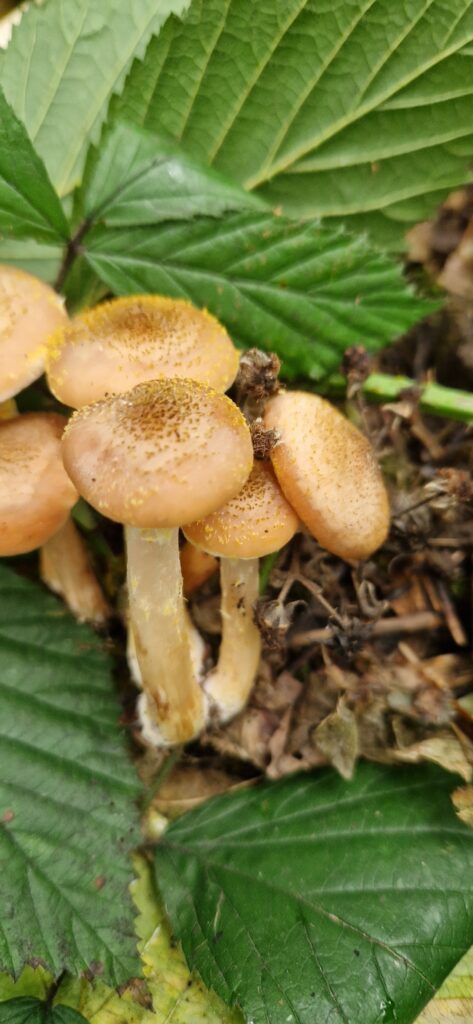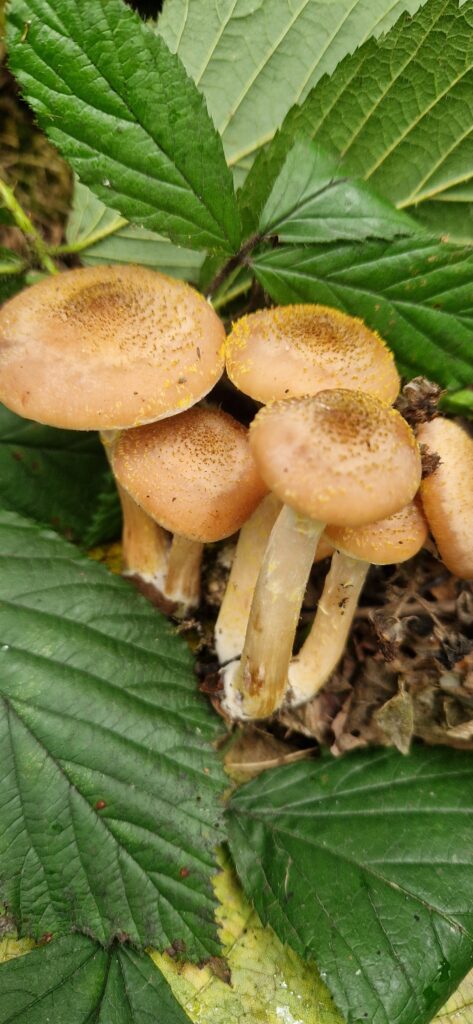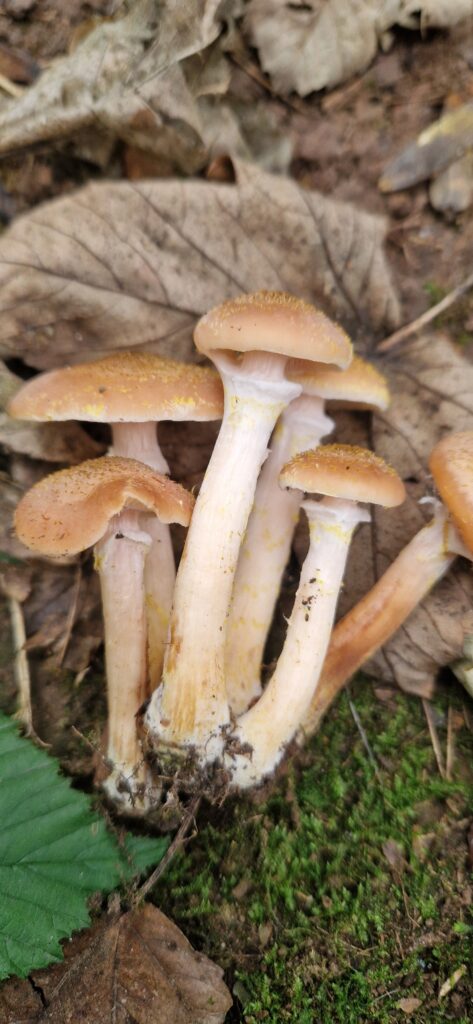
Honey Fungus (Armillaria mellea) is one of the most recognisable and talked-about woodland fungi. Known for its honey-coloured caps, clustered growth, and parasitic behaviour, it is both an important ecological species and a controversial edible. While eaten by some foragers, it must be approached with care and respect.
Not sure about mushroom identification? Join us for the next foraging course in Charnwood, Leicestershire, and learn how to safely identify fungi in the wild.
Habitat
Honey Fungus grows on living and dead trees, buried roots, stumps, and woody debris. It is commonly found in woodlands, parks, gardens, and hedgerows, affecting both deciduous and coniferous trees. Fruiting bodies usually appear in large clusters, often at the base of trees or emerging from the ground above infected roots.
Identification features
Cap:
Caps are 5–15 cm across, convex at first, flattening with age. They are typically honey-yellow to brown, sometimes darker in the centre, and may be covered with fine scales, especially when young.
Gills:
The gills are white to pale cream, becoming slightly yellowish with age. They are attached to the stem and fairly crowded.
Stem:
Stems are tough and fibrous, often darker toward the base, and usually feature a distinct ring (annulus) — a key identification feature for many Honey Fungus species.
Flesh:
White and firm, becoming tough as the mushroom matures.
Spore Print:
White.
Smell and Taste:
Mild to slightly mushroomy when young.
Lookalikes
- Sheathed Woodtuft (Kuehneromyces mutabilis) – smaller, neater, and growing on wood
- Sulphur Tuft (Hypholoma fasciculare) – toxic, with greenish gills
- Other brown clustered fungi – careful identification is essential
Edibility
Honey Fungus is edible for some people, but causes digestive upset in others. It must be thoroughly cooked, and it is recommended to try only a small amount the first time. Older specimens are often tough and best avoided.
Because of variable reactions and species complexity, Honey Fungus is not recommended for beginners.
Ecological role
Honey Fungus is both a saprotroph and a parasite. It is famous for producing rhizomorphs — black, bootlace-like strands that spread underground and infect tree roots. Some Honey Fungus individuals are among the largest and oldest living organisms on Earth.
Foraging season
Honey Fungus typically fruits from late summer through autumn, often appearing after periods of rain. Large flushes can occur year after year in the same location.
Health warning
Correct identification is essential, as Honey Fungus grows alongside toxic lookalikes. It can cause gastric upset, even when cooked, and reactions vary between individuals. Always cook thoroughly, avoid alcohol when trying for the first time, and only consume if you are completely confident in identification.
Foraging for wild mushrooms is a rewarding experience, but safety should always come first. If you’re interested in learning more, join one of our foraging courses at Charnwood Foraging, where you can gain hands-on experience with expert guidance!