
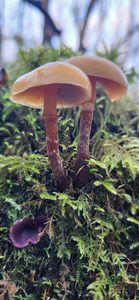
A small, unassuming woodland mushroom carrying one of the most dangerous toxins found in the fungal world. Funeral Bell is a species every mushroom enthusiast should learn to recognise – not for the table, but for its importance in foraging safety.
Not sure about mushroom identification? Join us for the next foraging event in Charnwood, Leicestershire.
Habitat
Found growing on dead and decaying wood, particularly conifer stumps, fallen branches and rotting logs. It can also occur on deciduous hardwood. Often appears in small clusters or groups, sometimes emerging from moss-covered wood.
Identification Features
Cap: Small, typically 1–7 cm across. Initially rounded or bell-shaped, becoming convex and eventually almost flat. Usually tawny, honey-brown or rusty brown, often with a paler yellowish margin. The cap is hygrophanous, meaning its colour changes as it loses moisture, becoming noticeably paler when dry.
Gills: Closely spaced, initially pale yellowish-brown or ochre, becoming rusty brown as the spores mature. Attached to the stem.
Stem: Slender and often slightly curved, usually brown towards the base and paler towards the top. A delicate, pale ring may be present, although this can disappear as the mushroom matures. The stem often has fine, whitish fibres.
Spore Print: Rusty brown.
Smell: Sometimes described as faintly mealy or flour-like.
Lookalikes
One of its most dangerous lookalikes is Sheathed Woodtuft (Kuehneromyces mutabilis), an edible mushroom that also grows in clusters on decaying wood. Both species can have brown caps, rusty-brown spores and a ring on the stem.
Funeral Bell may also be confused with young Honey Fungus (Armillaria species) and other small brown wood-growing mushrooms.
These similarities make accurate identification particularly important. Differences in stem texture, cap colour, habitat and microscopic features can help specialists distinguish them, but no single feature should be relied upon.
Ecology & Traditional Uses
Funeral Bell is a saprobic fungus, meaning it obtains nutrients by breaking down dead organic material. By decomposing fallen wood and tree stumps, it helps recycle nutrients and contributes to the natural renewal of woodland ecosystems.
Despite its deadly toxicity, it plays a valuable role in the woodland environment. Like many fungi, it is an important reminder that not everything growing in nature is intended for human consumption!
Season
Late summer through autumn, although it can occasionally be found outside this period when conditions are favourable.
Health Warning
DEADLY POISONOUS – DO NOT EAT.
Galerina marginata contains amatoxins, the same group of highly toxic compounds found in the Death Cap (Amanita phalloides).
• Amatoxins can cause severe liver damage and may be fatal.
• Symptoms can be delayed for several hours, sometimes giving a false impression that everything is fine.
• Cooking, drying or freezing does not make this mushroom safe to eat.
Never collect small brown mushrooms growing on wood for consumption unless their identity has been established with absolute certainty.
If ingestion is suspected, seek emergency medical attention immediately. Do not wait for symptoms to appear. identification, but a single photograph is rarely sufficient to establish a mushroom’s identity safely.
Join us for a foraging adventure in Charnwood, Leicestershire! Whether you’re a beginner or a seasoned forager, our events are a great way to learn about and identify edible fungi in their natural habitat.


