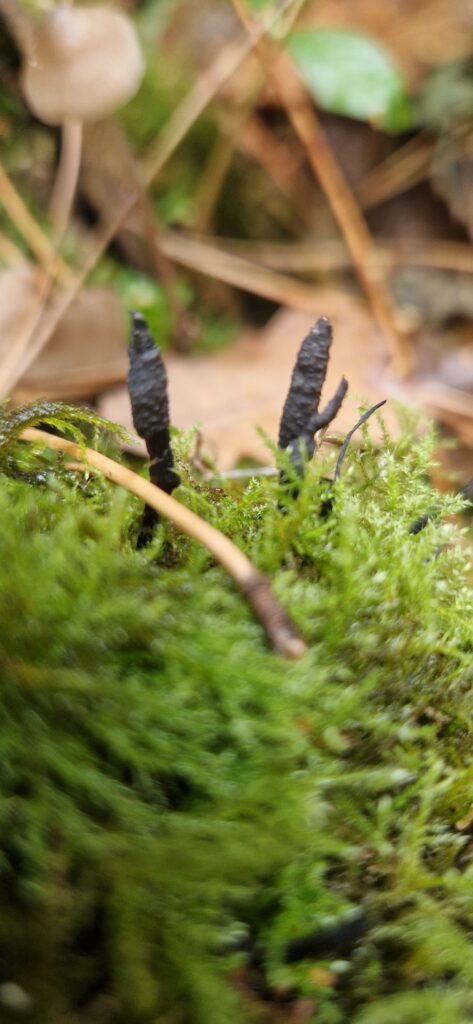
Dead Man’s Fingers (Xylaria polymorpha)
Dead Man’s Fingers is one of the most striking and eerie fungi found in UK woodlands. With its black, finger-like growths emerging from rotting wood, it’s easy to see how this species earned its macabre name. While not edible, this fungus fascinates foragers and nature lovers alike and plays an important ecological role in breaking down decaying wood and enriching forest soils.
Other names: “Dead Man’s Toes,” “Fingers of Death,” or simply “Xylaria.”
Not sure about mushroom identification? Join us for the next foraging course in Charnwood, Leicestershire, to learn more about identifying wild mushrooms safely.
Habitat
Dead Man’s Fingers is commonly found on decaying hardwood, especially around the bases of tree stumps or buried roots of species such as beech, ash, and sycamore. It thrives in damp, shaded areas of deciduous woodland and is widespread across the UK.
You’ll often see several “fingers” emerging together, giving the eerie impression of a hand reaching from the forest floor. This fungus appears throughout the year but is most noticeable in late spring and autumn when the fruiting bodies are fully developed.
Identification Features
Shape:
Club- or finger-shaped fruiting bodies that grow in small clusters, often resembling dark, charred fingers poking through the soil.
Colour:
Young specimens are pale grey to bluish with a whitish surface, becoming black, rough, and woody as they mature.
Size:
Typically 3–8 cm tall and up to 2 cm thick, though clusters may form much larger masses.
Texture:
Tough and dry to the touch, becoming hard and brittle over time.
Interior:
White when young, turning blackish and woody as it ages.
Similar Species
- Dead Moll’s Fingers (Xylaria longipes):
Slender and usually found on fallen branches rather than stumps. - Candlesnuff Fungus (Xylaria hypoxylon):
A smaller, branched species with white tips, often found on smaller twigs and rotting wood.
Edibility
Dead Man’s Fingers is inedible due to its tough, woody texture. Although not poisonous, it has no culinary value and should be appreciated for its unique appearance and ecological function rather than eaten.
Ecological Role
As a saprotrophic fungus, Dead Man’s Fingers helps decompose dead hardwood, recycling nutrients back into the soil and supporting healthy woodland ecosystems.
It provides valuable microhabitats for insects and microorganisms, contributing to biodiversity in UK woodlands. Without species like this, forests would struggle to renew themselves naturally.
Foraging Season
Dead Man’s Fingers can be spotted year-round, but they are most visible from spring through autumn. Older fruiting bodies often persist through winter, remaining black and finger-like long after other fungi have decayed.
If you’re out foraging in Leicestershire woodlands, keep an eye on the bases of old tree stumps — that’s where these mysterious fungi often appear.
Folklore and Curiosity
Historically, Dead Man’s Fingers has been linked to folklore and superstition. Its unsettling, finger-like shape was seen as a symbol of death or bad luck, especially when found near graves. Today, foragers and photographers value it as one of the most visually striking fungi in the UK.
Health Warning
Dead Man’s Fingers is not edible. Always avoid eating any wild mushrooms unless you are 100% confident in their identification. Many fungi can look similar, and misidentification can be dangerous.
If you’d like to learn to identify wild mushrooms safely and responsibly, join our foraging courses in Charnwood, Leicestershire, where you’ll explore edible and inedible species in their natural habitats.
Join a Foraging Course
👉 Join our next foraging course in Charnwood, Leicestershire Whether you’re a beginner or a seasoned forager, there’s always something new to discover!