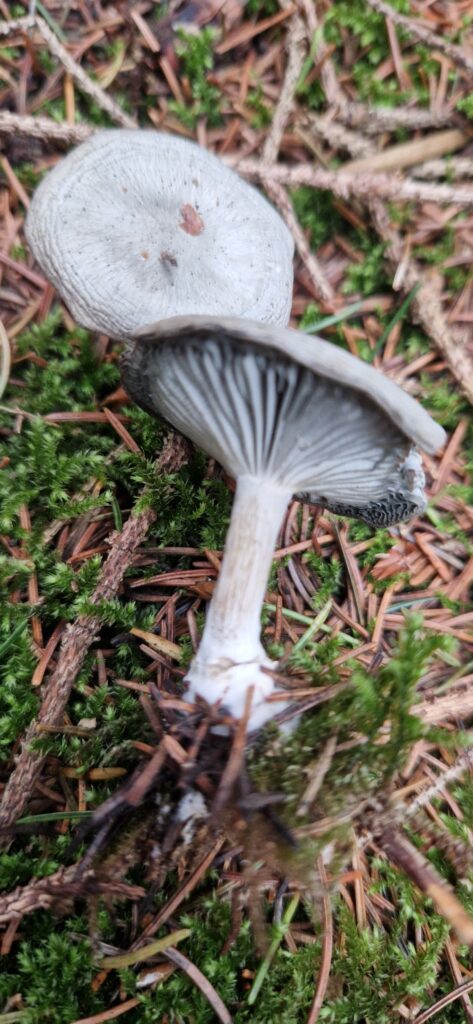
This beautiful blue-green mushroom stands out for its distinct aniseed or liquorice scent — you’ll often smell it before you see it! It grows in damp woodlands among leaf litter and moss, usually from late summer to early winter.
Other names: Aniseed Toadstool, Aniseed Clitocybe
Not sure about mushroom identification? Join us for the next foraging event in Charnwood, Leicestershire.
Habitat
The Aniseed Funnel is typically found in deciduous and coniferous woodlands, particularly among leaf litter, moss, or damp soil. It often grows singly or in small groups, sometimes forming loose rings. This mushroom prefers humus-rich woodland floors and can often be found near beech, oak, or pine trees.
Identification Features
Cap: Usually 3–8 cm across, convex when young, later becoming flat or slightly depressed in the centre. Its distinctive blue-green to grey-green colour fades with age. The surface is smooth and may appear slightly greasy when damp.
Gills: Decurrent, pale with a bluish tint, and crowded beneath the cap.
Stem: 3–6 cm tall, fibrous, and often paler than the cap. It may appear slightly powdery near the top.
Smell: Strongly reminiscent of aniseed or liquorice — one of the most distinctive identification features.
Texture: Firm and dry.
Spore Print: White.
Edibility
The Aniseed Funnel is edible when cooked and valued for its distinctive aroma. However, due to its strong flavour, it’s best used as a flavouring mushroom rather than a main ingredient. Always avoid consuming raw, and never eat any wild mushroom unless you’re 100% sure of identification.
Recipes
This mushroom pairs beautifully with fish, poultry, or creamy sauces.
Try finely chopping and sautéing with butter to release its sweet aroma, or add small amounts to soups or risottos for a subtle aniseed note.
Vitamins Content / Health Benefits
While not widely known for medicinal properties, the Aniseed Funnel is believed to contain antioxidants and trace minerals common to many wild fungi. Its delightful aroma makes it an enjoyable addition to a balanced foraged diet.
Foraging Season
You can find the Aniseed Funnel from late summer through early winter (August to December), depending on local weather conditions. It’s often easier to locate in damp, shaded woodland areas after periods of rain.
ite, and the mushroom has a pleasant smell. As with any wild mushroom, avoid consumption if you are unsure about its identity.
Join us for a foraging adventure in Charnwood, Leicestershire! Whether you’re a beginner or a seasoned forager, our events are a great way to learn about and identify edible fungi in their natural habitat.