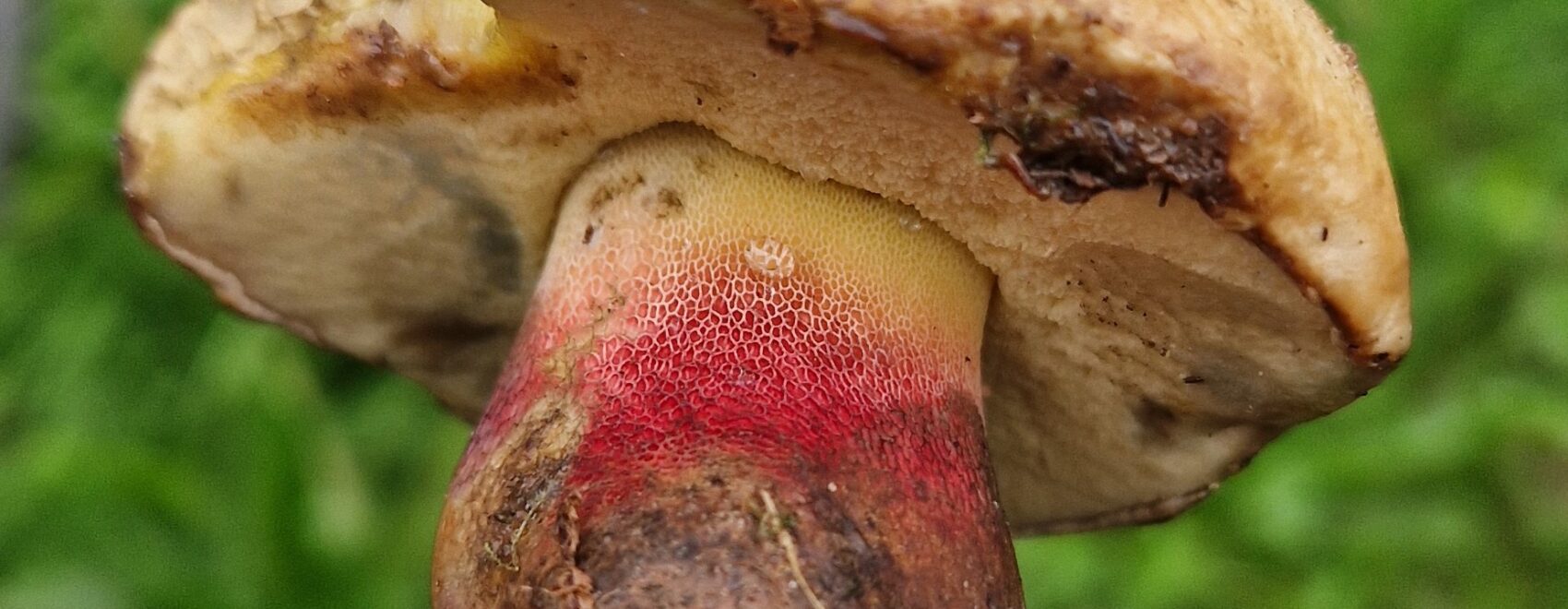
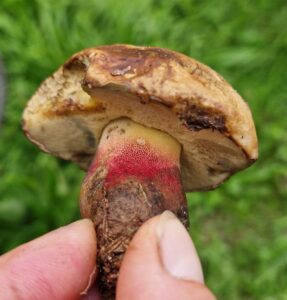
The Bitter Beech Bolete (Caloboletus calopus), also known as the “Bitter Bolete” or “Scarlet-stemmed Bolete,” is a striking yet inedible mushroom found primarily in beech and oak forests. It is easily recognized by its vibrant stem and bitter taste, which distinguishes it from other boletes.
Other names: “Bitter Bolete” or “Scarlet-stemmed Bolete.”
Not sure about plant identification? Join us for the next foraging event in Charnwood/Leicestershire.
Habitat
- The Bitter Beech Bolete is commonly found in association with beech and oak trees, although it can occasionally be found under other deciduous trees. It prefers acidic soils and is usually located in mixed or broadleaf woodlands. This mushroom is widespread across Europe and parts of North America, appearing from late summer through autumn.
Identification features
- Cap: The cap of the Bitter Beech Bolete ranges from 5 to 15 centimeters in diameter. It is typically a dull brown to olive-brown color, with a smooth or slightly velvety texture. The flesh is yellowish and turns blue when cut or bruised, a common characteristic among many boletes.
- Stem: The stem, or stipe, is one of the most distinctive features of this mushroom. It measures between 7 to 15 centimeters in height and 2 to 4 centimeters in thickness. The stem is bright yellow near the top, transitioning to a deep red or scarlet color towards the base, with a reticulate (net-like) pattern on the upper portion.
- Pores: The pore surface beneath the cap is bright yellow, turning olive-brown with age. When bruised, the pores stain blue, another common feature of this species.
Edibility
- The Bitter Beech Bolete is not considered edible due to its intensely bitter taste, which remains even after cooking. While it is not toxic, its bitterness makes it unsuitable for culinary use. Foragers should be cautious not to confuse it with other, edible boletes.
Recipes
None unless you like something disgusting and unpalatable.
Vitamins Content/Health Benefits
none
Foraging season
- The Bitter Beech Bolete typically appears from late summer through autumn, with peak fruiting in September and October. Climate changes have led to occasional earlier appearances, sometimes as early as July, depending on regional weather patterns.
Health warning
- When foraging, it’s crucial to correctly identify the Bitter Beech Bolete to avoid mistaking it for edible species. Its intensely bitter taste is a reliable identifier, but it should not be consumed. As with all wild mushrooms, consulting an expert or using a reliable field guide is advised to ensure safe identification.