With its shaggy brown scales, pale cap and flesh that turns reddish when cut, the Shaggy Parasol is a striking woodland mushroom. Although regarded as edible by some foragers, it can cause unpleasant digestive reactions and has lookalikes that require careful identification.
Not sure about mushroom identification? Join us for the next foraging course in Charnwood, Leicestershire, and learn how to safely identify fungi in the wild.
Habitat
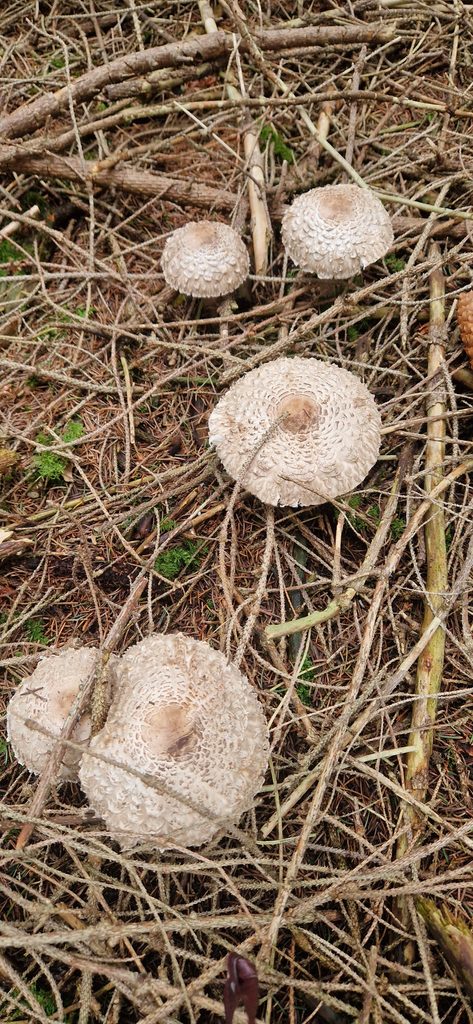
The Shaggy Parasol is commonly found in Britain, growing in woodland, along hedgerows, in shady places, parks and gardens. It may appear singly, in small groups or in rings, often during damp conditions in late summer and autumn.
Identification Features
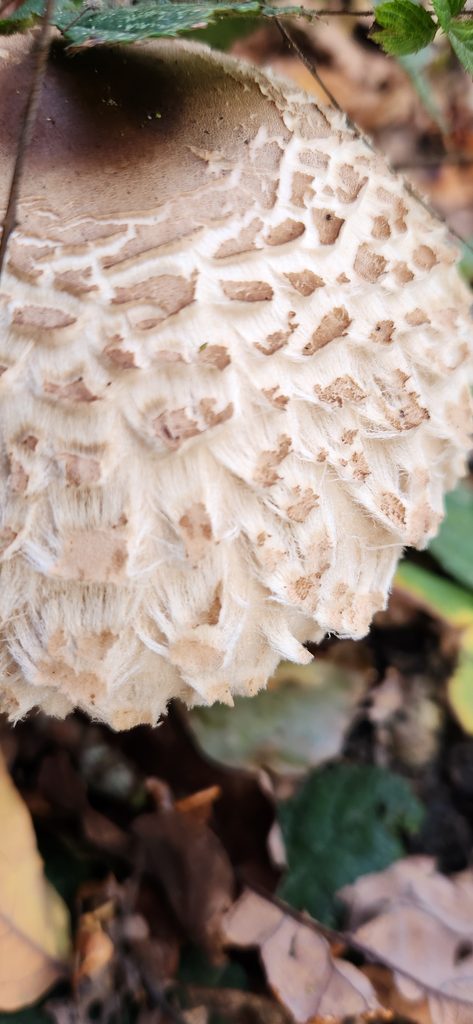
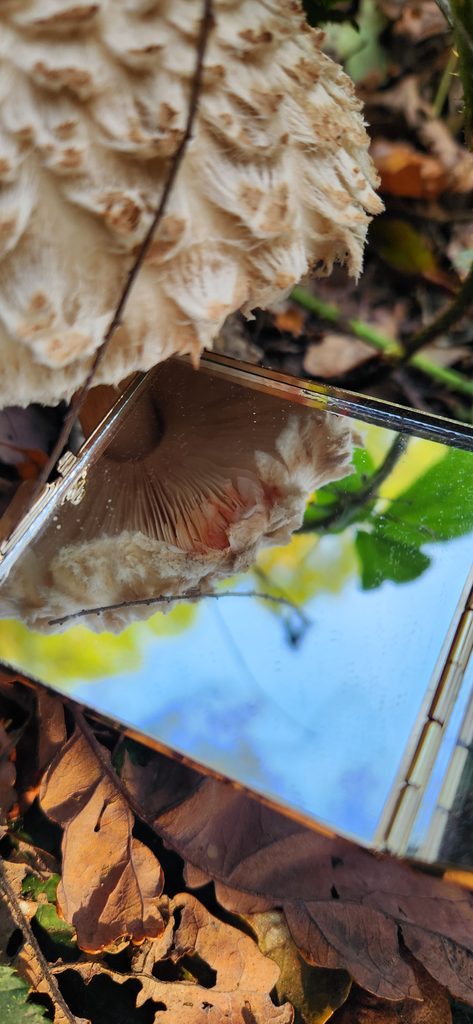
- Cap: Initially egg-shaped or rounded, opening into a broad, convex cap, typically around 5–20 cm across. The pale cream background becomes covered with shaggy, upturned brown scales, often with a smoother, darker brown centre.
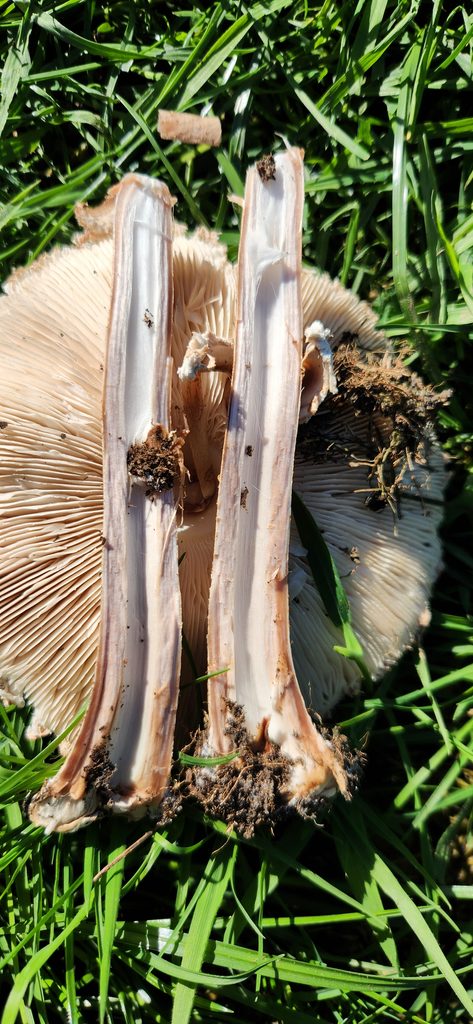
- Gills: Crowded, soft and free from the stem. They are initially white or creamy and may develop pinkish or reddish-brown staining when bruised.
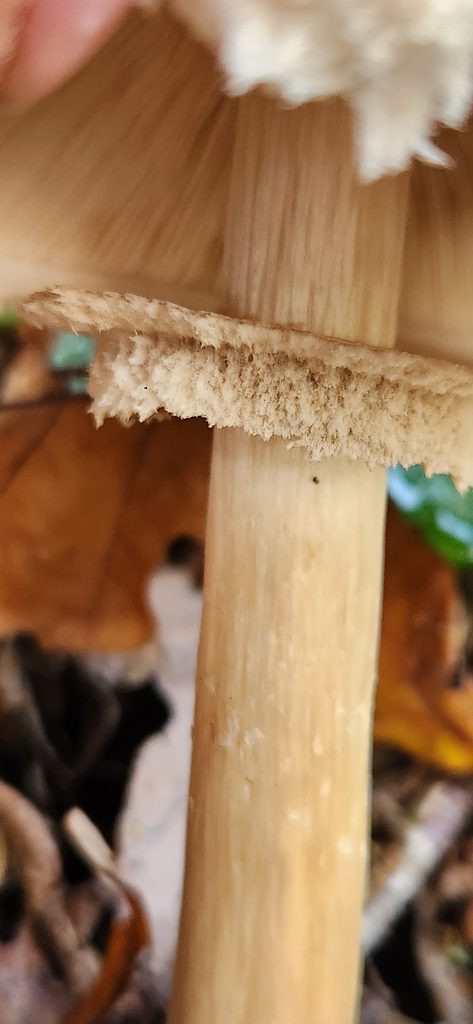
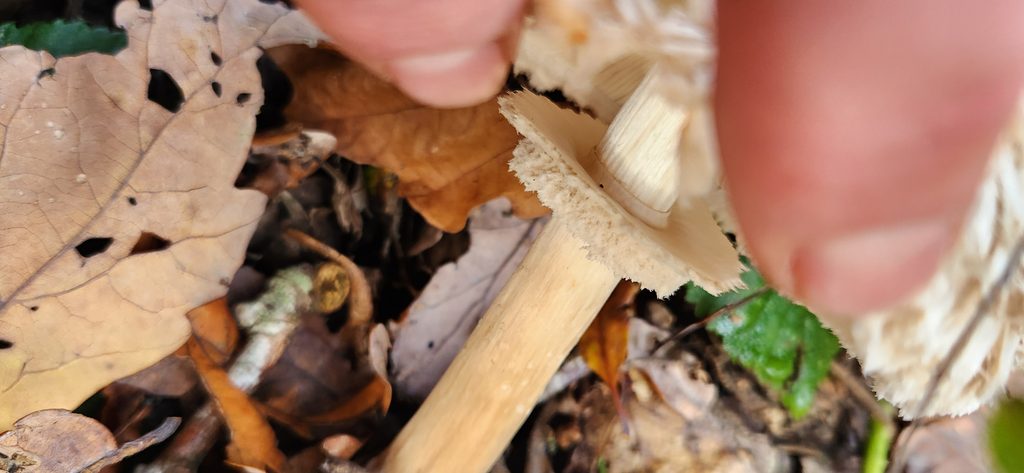
- Stem: Generally pale and smooth, without the distinctive brown, snakeskin-like pattern found on the true Parasol Mushroom. The base is swollen or bulbous.
- Ring: A prominent, often double-edged ring sits around the stem and may become loose enough to move up and down.
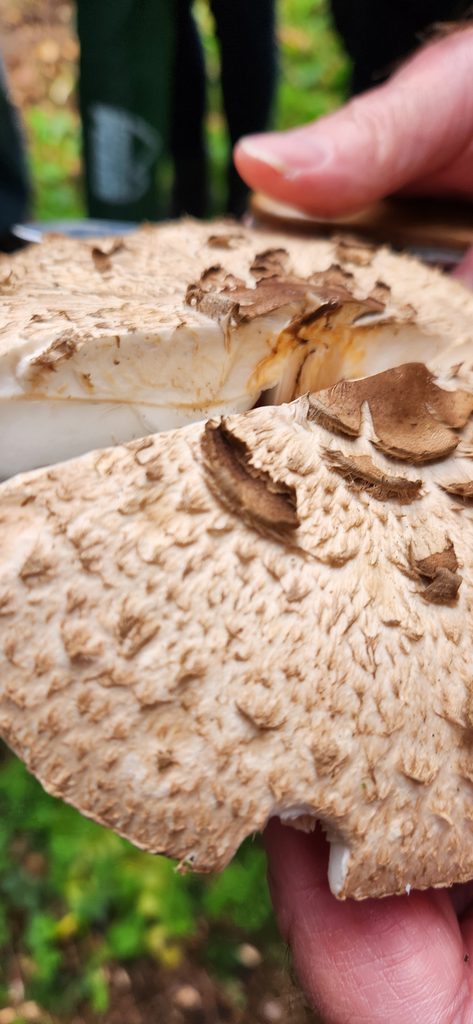
- Flesh: White when fresh, turning orange-red or reddish-brown when cut or bruised. This colour change is a useful identification clue, but it is not sufficient on its own to confirm the species.
- Spore print: White to pale cream.
- Smell: Usually mild and mushroom-like, sometimes described as sweet or slightly aromatic.
Look at the entire mushroom, including the cap, gills, stem, ring and swollen base. Young specimens can look very different from mature ones.
Lookalikes
Several other mushrooms resemble the Shaggy Parasol, and some can cause poisoning.
- Parasol Mushroom (Macrolepiota procera): Usually taller and more slender, with a distinctive brown, snakeskin-like pattern on its stem. Its flesh does not typically turn reddish when cut.
- Brown Parasol (Chlorophyllum brunneum): A close relative that can cause gastrointestinal upset. It may have a strongly swollen stem base with a distinct rim and a different ring structure. Distinguishing these species can be difficult.
- Other parasol-like mushrooms: Some smaller species, including members of the Lepiota group, are poisonous, and some are potentially deadly. Do not assume that a scaly cap and ring identify a safe mushroom.
Never identify a mushroom from one feature alone. If you are uncertain, leave it where it grows.
Edibility
Edibility: Edible with caution, but not suitable for inexperienced foragers to collect for consumption.
The Shaggy Parasol is regarded as edible when thoroughly cooked, but some people experience gastrointestinal reactions, including nausea, vomiting, diarrhoea and abdominal pain. Cooking does not eliminate the risk of individual intolerance or misidentification.
Anyone considering eating this species must be absolutely confident of the identification and aware of the risks. Never eat raw or undercooked specimens, and never use a taste test to identify a mushroom.
Ecology & Traditional Uses
The Shaggy Parasol is a saprotrophic fungus, obtaining nutrients from organic matter and helping recycle nutrients within woodland and other habitats.
Its tendency to produce mushrooms in rings is connected to the outward growth of its underground mycelium. Such rings have inspired traditional European folklore about fairy rings and enchanted woodland places.
There are no well-established medicinal uses for this species.
Season
The Shaggy Parasol is usually found from summer into autumn, commonly between July and November in Britain, depending on local conditions and the weather.
Look for it after periods of rainfall in shady woodland, along hedgerows and in other suitable habitats.
Health Warning
Photographs alone may not provide enough information for a safe identification.
Never eat a wild mushroom unless it has been confidently identified using several reliable features.
Do not rely on red staining, a movable ring or a shaggy cap as proof of identity.
Be particularly cautious when distinguishing the Shaggy Parasol from the Brown Parasol and other similar species.
Some people react badly to Shaggy Parasols even when they are properly cooked.
Join us for a foraging adventure in Charnwood, Leicestershire! Whether you’re a beginner or a seasoned forager, our events are a great way to learn about and identify edible fungi in their natural habitat.